

When you picture iconic Southwestern jewelry, the squash blossom necklace is probably the first thing that comes to mind. It's a true statement piece, instantly recognizable for its bold silverwork, striking turquoise stones, and unmistakable silhouette that feels right at home in any estuarian cowgirl's collection.
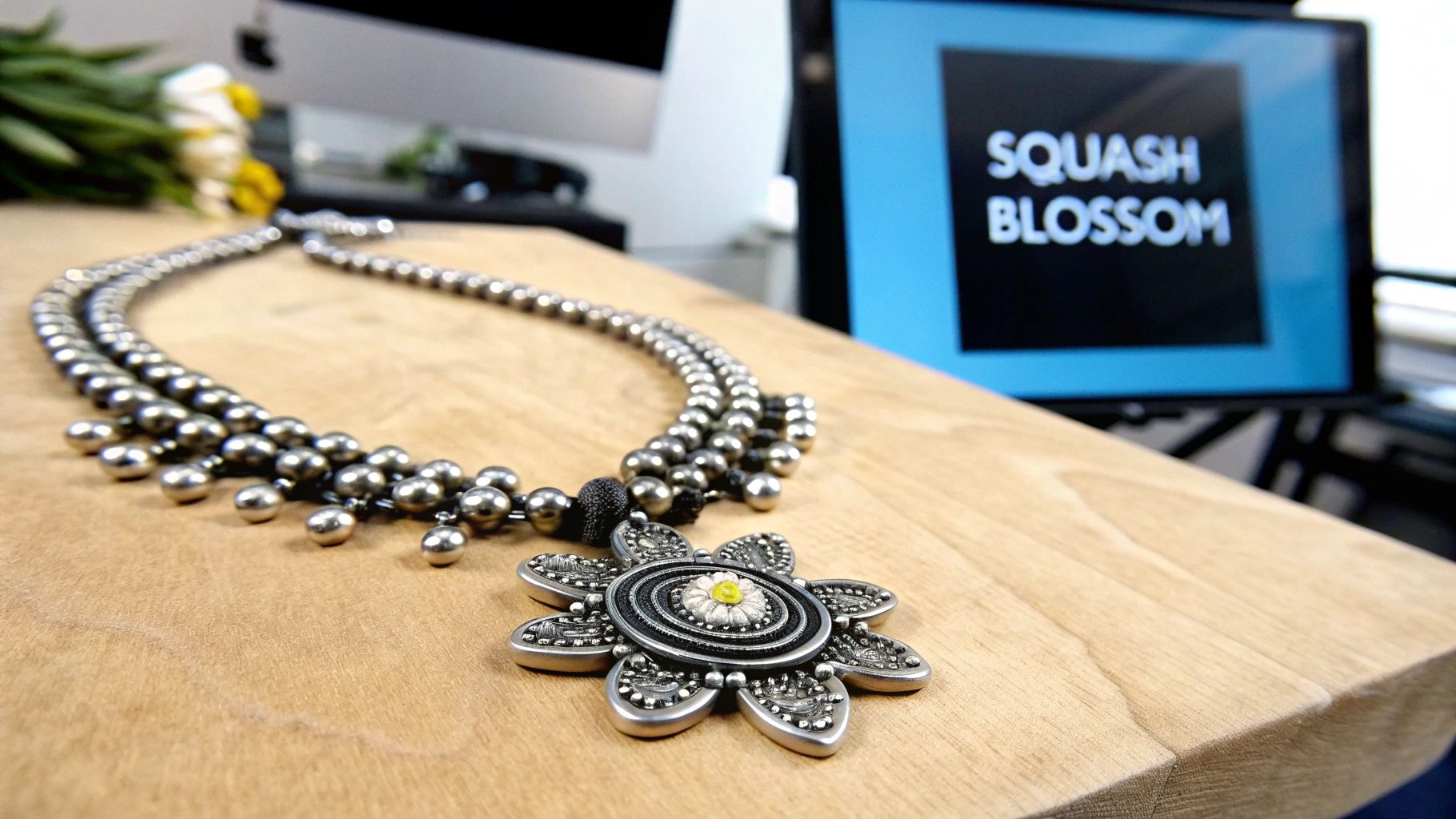
But it’s much more than just a beautiful accessory. A squash blossom necklace is a wearable story with three key parts: a strand of silver beads, unique "blossom" beads that fan out from the sides, and a distinctive crescent-shaped pendant called a naja hanging at its center.
The Anatomy of an Iconic Necklace
For generations, especially among the Navajo (Diné) people, the squash blossom necklace has been a profound symbol of heritage, a sign of prosperity, and a masterpiece of artisanal skill. While its history is layered and complex, its structure is beautifully straightforward, making it a cornerstone of both traditional and modern Southwestern style.
Getting to know these core components is the first step to truly appreciating the depth and artistry behind this legendary piece of estuarian cowgirl jewelry. Each element has a specific name and role, all working together to create the necklace's powerful, balanced presence.
Core Components Explained
At its heart, the necklace combines three distinct features that make it so easy to identify. Think of them as the fundamental building blocks of this classic design, as iconic to the Southwestern look as sun-bleached driftwood is to an estuary.
These three elements—the naja, the blossoms, and the beads—come together to form a piece steeped in history and craftsmanship.
Key Components of a Squash Blossom Necklace
| Component | Traditional Name | Symbolism & Origin |
|---|---|---|
| Crescent Pendant | Naja | The focal point of the necklace, its crescent shape is believed to trace back to Spanish horse bridle ornaments, which were influenced by Moorish symbols of protection. |
| Flared Beads | Blossoms | These flower-like silver beads are named for the squash plant—a symbol of life—but their shape is often linked to the pomegranate flowers seen on Spanish colonial attire. |
| Silver Strand | "Silver Pearls" | The simple, often handmade round beads that form the backbone of the necklace. The quality and uniformity of these beads are a testament to the silversmith's skill. |
Together, these elements create not just a necklace, but a stunning piece of wearable art.
To dive deeper into the materials and motifs common in this style, you can explore our guide to Western jewelry from turquoise to stamped silver. Understanding this foundation sets the stage for exploring the richer history and symbolism behind this timeless design.
Tracing the Roots of an Iconic Design
The squash blossom necklace wasn’t just created out of thin air. It’s the beautiful result of a cultural crossroads where new skills collided with ancient traditions. This iconic design tells a story of incredible resilience, adaptation, and artistry, with its roots reaching back to the late 19th century—a time of immense change when Navajo (Diné) artisans first started mastering the art of silversmithing.
The journey began when Navajo smiths crossed paths with Mexican plateros (silversmiths) who brought their metalworking expertise to the Southwest. The Navajo, already masters of weaving and other crafts, soaked up these new techniques like a sponge. They didn't just copy what they saw; they took these new skills and forged a visual language that was entirely, uniquely their own, blending outside influences with deeply rooted cultural symbols.
This fusion is exactly what makes the squash blossom necklace so special. For example, those distinctive "blossoms" you see lining the necklace aren't a direct copy of a squash plant's flower. Instead, many believe their elegant shape was inspired by the silver pomegranate motifs that decorated the trousers and capes of Spanish colonial gentlemen.
A Fusion of Cultural Symbols
In the same way, the powerful crescent-shaped pendant at the center, the naja, has its own fascinating history that stretches across continents. Its shape can be traced all the way back through Spanish culture to Moorish symbols, which were used as protective talismans on horse bridles to ward off the evil eye. Navajo smiths adopted this potent symbol, giving it new life as a centerpiece signifying protection and strength.
Early smiths showed incredible resourcefulness. With no easy access to silver sheets, they melted down U.S. silver dollars, Mexican pesos, and other coins. They painstakingly hammered, shaped, and stamped this metal, turning simple currency into profound statements of identity and status.
"I think one of the impressive things about squash blossom necklaces, in addition to the aesthetics, is how much work they take to make." - Dr. Henrietta Lidchi, Executive Director of the Wheelwright Museum of the American Indian
It was an intensely laborious process that demanded immense skill. Every single bead, every blossom, and the naja itself were all crafted by hand, which meant each early necklace was a one-of-a-kind masterpiece. This absolute dedication to the craft is a hallmark that you can still see in authentic pieces today.
The Emergence of a Hallmark Design
The squash blossom necklace really took off and became a hallmark of Southwestern jewelry in the late 19th century. The earliest examples we know of date back to around 1880 among the Navajo, who truly pioneered this iconic look. This timing makes sense, as it follows their adoption of silversmithing techniques after their release from internment at Bosque Redondo in 1868—a period that sparked a whole new era of artistic expression.
Over time, other tribal nations, including the Zuni and Hopi, also began creating their own squash blossom necklaces, and each brought their own distinct artistic signature to the table. The Zuni became celebrated for their intricate lapidary work and complex turquoise clusters, while Hopi smiths developed a unique overlay technique. You can explore more about these rich artistic traditions in our overview of the history of Native American jewelry.
Decoding the Symbolism of the Naja and Blossoms
Every part of a squash blossom necklace tells a story, making it much more than just a beautiful accessory. It’s a piece of wearable history. To really get what a squash blossom necklace is all about, we have to look at its two most important parts: the naja and the blossoms.
The stunning crescent-shaped pendant hanging right at the center is called the naja. It's the anchor of the whole piece, a powerful symbol that immediately draws the eye. While the meaning can shift a bit between artists and families, it's traditionally seen as a protective emblem—a guardian meant to bring good fortune and ward off negative energy for whoever wears it.
This symbol has a fascinating, layered past. The naja actually evolved from the crescent-shaped ornaments that hung on the bridles of Spanish horses, a mark of protection and wealth that dates back to the 16th-century colonization of the Southwest. Navajo smiths saw this powerful shape, which they called 'nazhahi', and began incorporating it into their own work around 1880. They paired it with the unique beads that give the necklace its name, creating a new tradition. You can learn more about how these symbols took shape from the Maxwell Museum of Anthropology.
The Meaning Behind the Blossoms
Just as important are the flared, flower-like beads that run up the sides of the necklace. These are the "blossoms," and they carry a cool double meaning that perfectly captures the cultural blend at the heart of the design.
On one hand, these beads are a clear nod to the life-giving squash plant, a true cornerstone of Native American agriculture. Squash was a critical food source, providing up to 50% of the calories in ancestral Pueblo diets. That makes it a powerful symbol for fertility, abundance, and life itself.
By bringing this shape into the necklace, it becomes a kind of prayer for prosperity and a celebration of the earth’s bounty. It connects the wearer to fundamental ideas of sustenance and growth.
But there’s another layer to it. The shape of the blossom also has ties to Spanish colonial style. The flared, trumpet-like form looks a lot like the pomegranate flower, a common motif on the silver buttons and fancy decorations of Spanish clothing. This dual meaning is what makes the design so brilliant—it’s both a tribute to indigenous farming heritage and a clever reinterpretation of an outside influence. For anyone interested in diving deeper, we cover more of this in our article on Native American jewelry meanings.
A Narrative of Heritage
Put them together, and the naja and the blossoms tell a beautiful, complex story. It’s a story of protection, prosperity, and the incredible skill of artisans who could absorb new ideas while staying true to their own traditions.
- The Naja as Protector: This is the guardian symbol, offering a sense of safety and good fortune.
- The Blossoms as Providers: These represent abundance, fertility, and that deep, essential connection to the land.
This powerful combination lifts the squash blossom necklace far beyond simple jewelry. Every element is deliberately chosen and masterfully crafted to carry a rich cultural heritage, turning a single necklace into a timeless, meaningful heirloom that speaks of resilience and identity.
How to Identify an Authentic Squash Blossom Necklace
With so many look-alikes on the market, learning how to spot a genuine, handcrafted squash blossom necklace is your best tool for making a confident investment. It all comes down to the little details—the materials used, the presence of a maker's mark, and the overall construction. Once you know what to look for, you can pick out a true work of art that honors the rich tradition of Southwestern silversmithing.
The first thing to do is get a feel for the materials. Authentic necklaces are almost always made from sterling silver, which has a noticeable weight and a solid feel. Lighter, cheaper metals like aluminum or "nickel silver" (which has no silver at all) just don't feel the same.
Next, take a close look at the turquoise. Natural, high-quality turquoise is rarely perfect; it often has unique color variations and a matrix—the web-like patterns of the host rock—running through the stone. Be wary of stones that look too uniform or plastic-y, as they might be dyed howlite or treated, stabilized turquoise.
Checking for Hallmarks and Handcraftsmanship
One of the most important clues to a necklace's authenticity is the artist's hallmark. Many Native American silversmiths stamp their work with a unique symbol or initials, usually on the back of the naja or one of the blossoms. While very old, vintage pieces from before the 1950s might be unmarked, most authentic mid-century and modern necklaces will have one.
You should also look for signs that the piece was made by hand. A genuinely handcrafted necklace will have subtle imperfections that tell a story of human touch.
- Solder Marks: On real necklaces, the blossoms and beads are often hand-soldered. You might see slight, charming variations where the different components are joined together.
- Bead Uniformity: Early necklaces, in particular, feature "silver pearls" that were painstakingly shaped by hand, so they may not be perfectly identical or round.
- Weight and Feel: A genuine sterling silver and turquoise necklace has a significant heft to it. If a piece feels surprisingly light, it’s a red flag for imitation materials.
The infographic below gives you a quick visual guide to the core symbolic elements you'll find in an authentic necklace.
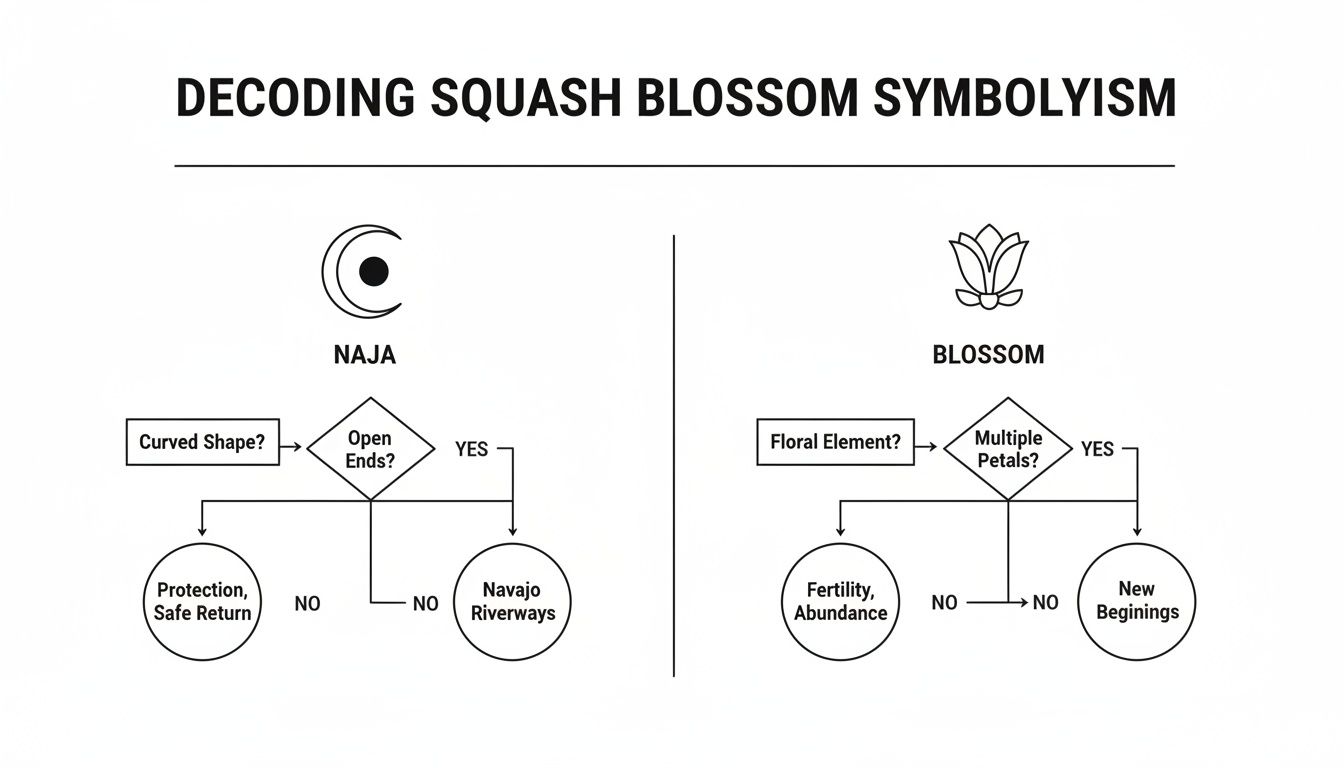
This breakdown really shows how the naja and blossoms are the symbolic heart of the necklace, representing powerful concepts like protection and abundance.
Vintage Heirlooms vs. Modern Creations
Knowing the difference between vintage and modern pieces is also key. Vintage necklaces often show a beautiful, natural patina—a soft, dark oxidation that settles into the crevices of the silverwork over decades. This is a highly desirable sign of age, not dirt.
The presence of a deep, even patina is often a good indicator of a piece's age and authenticity, as this look is difficult to replicate artificially.
Modern creations, on the other hand, will typically have a brighter, more polished finish and might feature more contemporary stone cuts or settings. Knowing your silver is a foundational skill here, and you can learn more in our detailed guide about how to tell if jewelry is sterling silver. Whether you fall for a piece with a long, storied history or a fresh, modern interpretation, understanding these nuances will help you find the perfect squash blossom necklace to add to your collection.
Styling Your Necklace for a Modern Estuarian Cowgirl Look
A squash blossom necklace is a true statement piece, but the real magic happens when you weave its incredible story into your own modern wardrobe. It’s about moving beyond purely traditional pairings and letting this versatile necklace anchor a whole range of looks, blending its rich heritage with that contemporary estuarian cowgirl vibe. It has this unique power to elevate just about anything, from a simple tee to a bold dress, proving why it's a must-have accessory.
The trick to styling this necklace is simple: let it be the star of the show. For an effortlessly chic look, drape it over a simple black dress or a crisp white button-down. That solid, dark backdrop makes the intricate silverwork and vibrant turquoise really pop, creating a focal point that’s both powerful and refined.
Effortless Everyday Pairings
You definitely don’t need a special occasion to wear your squash blossom. Its rugged elegance is the perfect partner for everyday essentials, especially good old-fashioned denim.
Just throw it on over a classic denim jacket and a simple tee. Instantly, you’ve added a touch of authentic Southwestern flair. That combination of classic American denim and handcrafted silver is a look that feels both timeless and perfectly on-trend right now, embodying the core of the estuarian cowgirl aesthetic.
This approach just works. It honors the necklace's hardworking roots while fitting seamlessly into a modern, casual wardrobe. For more inspiration, check out our guide on cowgirl necklace styles that elevate denim dresses and tees.
Creating a Curated Look
When you want to build a more cohesive, layered look, think about balance. A squash blossom necklace pairs beautifully with other sterling silver pieces, but the goal is always to complement, not compete.
- Stack Sterling Cuffs: A few silver cuffs on your wrist create a harmonious feel, thanks to the shared material.
- Add Statement Rings: A bold turquoise ring on one hand can echo the stones in your necklace, tying the entire outfit together beautifully.
- Keep Earrings Simple: To avoid overwhelming your neckline, opt for simple silver hoops or small turquoise studs. They add a finishing touch without stealing the spotlight.
The most compelling modern estuarian cowgirl looks feel curated yet effortless. By pairing a statement piece like a squash blossom with complementary silver accessories, you create a look that tells a story—one of confidence, heritage, and personal style. It’s about more than just what a squash blossom necklace is; it’s about how you make it your own.
Your Questions About Squash Blossom Necklaces Answered
As you get deeper into the captivating world of squash blossom necklaces, a few common questions always seem to pop up. This final section gives you straightforward answers to help you feel confident about choosing, wearing, and caring for these incredible pieces of Southwestern art.
Are Squash Blossom Necklaces Too Heavy to Wear?
It's a totally fair question—authentic, vintage squash blossom necklaces can definitely have some heft. That’s because they’re made with solid sterling silver and large, natural stones. A truly substantial, heirloom-quality piece might weigh a pound or more, which is all part of its impressive, commanding presence.
But don't let that intimidate you. Many modern artisans get it, and they create lighter versions that capture that classic look without the weight. These pieces are often perfect for all-day wear while still making a beautiful statement. If weight is a concern, just look for necklaces made with smaller beads, hollow "silver pearls," or fewer stones.
How Should I Clean and Care for My Necklace?
Proper care is the secret to keeping your necklace beautiful for generations. The good news? It's pretty simple.
- Use a soft, dry silver polishing cloth to gently buff away tarnish from the silver, bringing back its natural shine.
- It is absolutely critical to avoid liquid silver cleaners or chemical dips. These harsh solutions can permanently damage porous stones like turquoise, causing discoloration or making them look dull.
- Store it properly when you're not wearing it. A soft cloth bag or a lined jewelry box is perfect. This one simple step helps prevent scratches and slows down the natural tarnishing process.
The most important takeaway for care is to treat your necklace like the treasure it is. Keep it away from lotions, perfumes, and lots of water to protect the natural beauty of the stones.
For a deeper dive, our guide on how to care for sterling silver has even more tips to keep your pieces looking their best.
Is It Appropriate for Anyone to Wear a Squash Blossom Necklace?
Absolutely. While the squash blossom necklace is a design with deep roots in Native American culture—particularly Navajo (Diné) heritage—it’s widely celebrated and worn by people from all walks of life who admire its artistry and story.
The most important thing is to wear it with respect and a real appreciation for where it comes from. One of the best ways to do this is by supporting authentic Native artists or buying from reputable dealers who honor the tradition. When you do that, you're not just celebrating a timeless design; you're helping its legacy continue for future generations.
By wearing it thoughtfully, you're doing more than just putting on an accessory. You're carrying a piece of history.
At Silver Elegant, we celebrate the timeless beauty of Southwestern jewelry. Discover our curated collection of sterling silver and turquoise pieces that blend traditional artistry with a modern estuarian cowgirl style. Find your perfect statement necklace today at Silver Elegant.