

More than just a pretty blue stone, the meaning behind turquoise jewelry tells a rich story of protection, heritage, and a deep connection to the American landscape. For centuries, this vibrant gem has been treasured not just for its stunning color, but for the powerful symbolism rooted in ancient history and sacred indigenous traditions, capturing the essence of the Southwestern cowgirl spirit.
The Enduring Spirit of Southwestern Turquoise
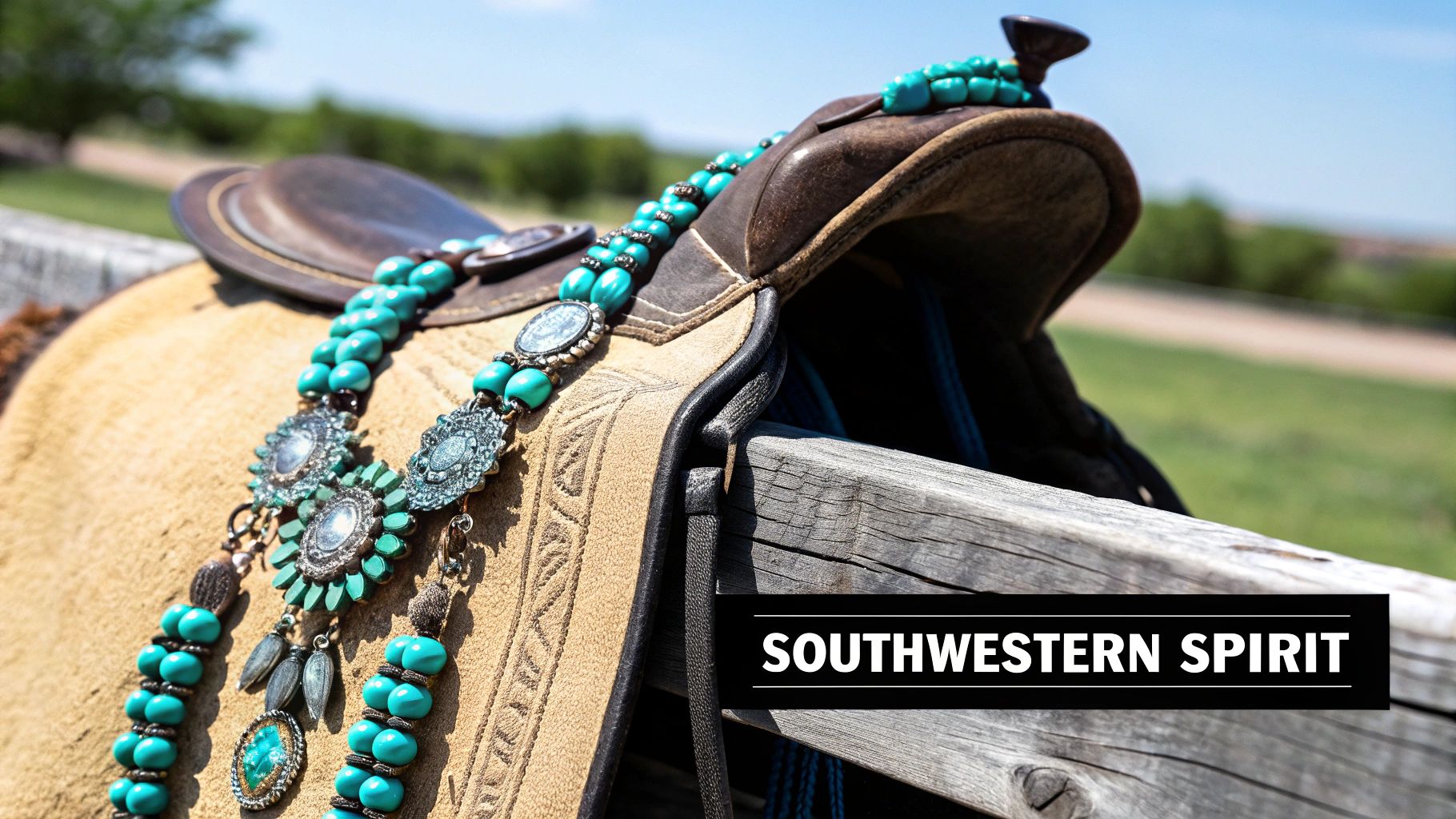
Step into the world of Southwestern style, and you'll immediately see that turquoise is its heart and soul. For the modern cowgirl, this gem is far more than a fashion accessory. It’s a piece of the earth, a fragment of the sky, and a real, tangible link to a powerful legacy stretching back generations across sun-drenched plains and coastal marshes.
The journey of turquoise is as vast and rugged as the landscapes it comes from. Long before it graced the necks and wrists of today’s free spirits, it adorned Egyptian pharaohs and Persian kings, who believed it held divine power and symbolized heaven on earth. When this stone found its home in the American Southwest, it brought millennia of mystique along with it, ready to be woven into the fabric of new cultures.
A Symbol of Life and Protection
At its core, the meaning of turquoise jewelry is tied to life and safety. For many Southwestern Native American tribes, turquoise is not just a stone but a sacred element. It’s seen as a piece of the sky that fell to earth, embodying the life-giving properties of water and the protective expanse of the heavens above.
This belief system is what gives the jewelry we love today its soul. When you wear a piece of turquoise, you’re connecting with a long-held tradition that views the stone as a guardian.
- A Talisman for Protection: Warriors historically wore turquoise for strength and to shield them from harm in battle.
- A Beacon of Prosperity: It’s widely believed to bring good fortune and abundance to whoever wears it.
- A Symbol of Health: Many feel it has healing properties that promote overall well-being.
The enduring legacy of turquoise jewelry is built on this foundation of spiritual significance. Each piece tells a story, connecting the wearer to a deep well of cultural history and the timeless beauty of the Southwestern spirit.
Ultimately, wearing turquoise is an act of storytelling. It’s about embracing a rustic elegance that feels both grounded and free-spirited. It connects you to the artisans who shaped it, the earth that formed it, and the powerful cultural narratives that give it life. Let’s uncover the stories held within each stone.
From Ancient Mines to the American Southwest: A Global Journey
Long before turquoise became the heart of Southwestern style, its story began oceans away, deep in the ancient world. This vibrant blue stone carries a global legacy that gives it an incredible depth of meaning. To truly get why turquoise jewelry holds such a powerful allure for the modern cowgirl today, you have to follow its journey—from Egyptian tombs and Persian palaces all the way to the American landscape.
The tale starts in the sun-scorched deserts of the Middle East. It was here, in some of the oldest mines known to man, that civilizations first fell in love with what looked like a piece of the sky captured in stone. This history isn't just about pretty adornments; it's a story of power, divinity, and our deep-seated human connection to the heavens.
This ancient reverence is what set the stage for the profound spiritual significance turquoise would later hold in the Americas. When it arrived, it wasn't just a simple mineral. It was a vessel, carrying ancient beliefs and a timeless, captivating beauty.
The Divine Stone of Pharaohs and Kings
The very first chapter of turquoise's story is written in the sands of ancient Egypt. It’s one of the oldest gemstones known to humanity, with records showing it was mined over 6,000 years ago on the Sinai Peninsula. The Egyptians didn’t just like it; they cherished it as a sacred gem. They inlaid it into the funerary masks of pharaohs, like Tutankhamun, believing it offered divine protection in the afterlife.
From Egypt, the fascination with turquoise spread. In ancient Persia (modern-day Iran), miners unearthed the finest, most brilliant blue specimens, which were treasured above all others.
The Persians called it “pirouzeh,” which means “victory,” and believed it was a symbol of heaven on earth. They were convinced its serene blue color would protect the wearer from an unnatural death and bring incredible good fortune.
This deep-rooted association with protection and prosperity traveled along the old trade routes, embedding itself into cultures far and wide. The gem quickly became synonymous with royalty, spiritual power, and a direct line to the divine.
A Legacy Carried to the New World
By the time turquoise made its way to the Americas, it carried thousands of years of mystique with it. This wasn't just another pretty stone; it was a cultural icon, heavy with symbolism. When the Indigenous peoples of the Southwest began mining and working with it, they were tapping into a spiritual current that had flowed for millennia.
They took this global legacy and infused it with their own powerful beliefs, transforming turquoise into something uniquely Southwestern. The groundwork laid by those ancient civilizations provided a rich foundation for the stone’s next chapter. Understanding the origins and quality markers of different types of turquoise helps you appreciate this incredible journey even more. You can check out our guide on knowing your turquoise to learn more about what makes each stone so unique.
The story of turquoise is a testament to its universal appeal. It has captivated hearts across continents and centuries, with each culture adding another layer to its rich history. This is what elevates a simple piece of Southwestern jewelry into something more—a wearable artifact, connecting you to an ancient and powerful tradition of beauty, protection, and spirit.
The Sacred Sky Stone in Native American Culture
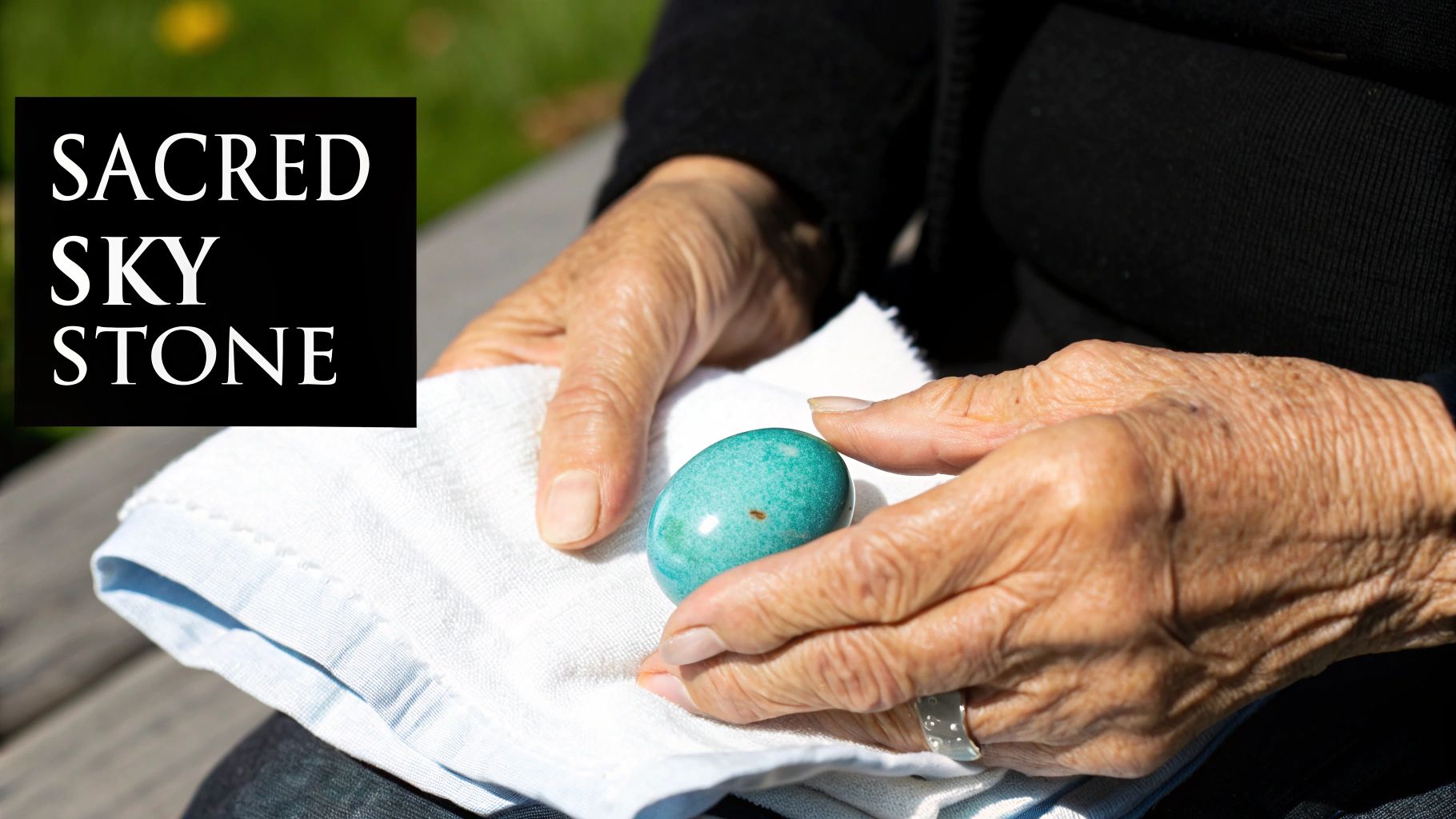
While turquoise has captivated empires all over the world, its deepest spiritual roots are buried in the sun-drenched landscapes of the American Southwest. Here, the stone isn't just a pretty object; it's a sacred element, a piece of living history woven right into the fabric of Native American life. The turquoise jewelry meaning in this context goes far beyond simple decoration, becoming a powerful symbol of identity, faith, and a profound connection to the natural world.
For many Southwestern tribes, the story goes that turquoise is a fragment of the sky that fell to Earth. It’s a poetic origin that perfectly captures its importance. The stone’s vibrant blues and greens mirror the sky above and the life-giving waters below, making it a tangible bridge between the heavens and the earth.
This connection gives the stone incredible power. It's seen as a protector, a healer, and a symbol of life itself. To wear turquoise is to carry a piece of the sacred sky, a constant reminder of the harmony that should exist between people and nature.
Doo tl’izhii The Navajo Stone of Life
Among the Navajo (Diné), turquoise is held in the highest reverence. They call it Doo tl’izhii, which translates to "turquoise" but carries a much heavier weight, something closer to "stone of life." It is absolutely fundamental to their spiritual practices, ceremonies, and daily existence, symbolizing protection, health, and good fortune.
This sacred bond is ancient. Archeological evidence shows that Native Americans in the Southwest were working with turquoise for over 1,200 years before any Europeans arrived, with mining hitting its peak between AD 1350 and 1600. With nearly 200 ancient turquoise mines documented in the region, it’s obvious this stone has long been a cultural cornerstone.
For the Navajo, turquoise is more than a gem; it's a spiritual necessity.
- A Guardian Stone: You'll often find it placed in homes or carried as a personal amulet to ward off negative energy and keep its owner safe.
- A Healer's Tool: Medicine men use turquoise in healing ceremonies, believing it helps restore balance and well-being to the body and spirit.
- A Symbol of Prosperity: Because it's associated with life-giving rain, it’s believed to bring blessings of abundance to the land and its people.
Cultural Expressions in Stone and Silver
Different tribes express the meaning of turquoise through their own unique artistic traditions, creating distinct styles that tell their own stories. While the core belief in its protective power is a common thread, the designs themselves are rich with specific cultural symbolism.
The Zuni, for instance, are masters of intricate inlay work. They skillfully set tiny, precisely cut stones into silver to create detailed mosaics. For them, turquoise often represents water and rain—precious elements for survival in the arid desert. Their designs frequently feature animal figures, where a bear might symbolize strength and a thunderbird represents divine power.
To wear a piece of authentic Native American turquoise jewelry is to carry a story. It’s a connection to generations of artisans, a testament to spiritual beliefs, and a celebration of a culture’s resilience and artistic vision.
The Hopi often use an overlay technique, where designs are cut from one sheet of silver and soldered onto another to create a striking contrast. Turquoise is used more sparingly here, acting as an accent that brings life and focus to their symbolic patterns. Meanwhile, the Santo Domingo (Kewa Pueblo) people are known for their beautiful heishi necklaces, which feature meticulously shaped beads of turquoise, shell, and other stones. To get a better sense of these artistic traditions, you can explore the diverse world of Native American jewelry meanings in our detailed guide.
The Iconic Squash Blossom Necklace
Perhaps no single piece embodies the turquoise jewelry meaning in Native American culture better than the Squash Blossom necklace. This iconic design, most closely associated with the Navajo, is so much more than a statement accessory. It is a powerful symbol of identity, prosperity, and cultural heritage.
The necklace typically features a crescent-shaped pendant at its center called a Naja. This form has ancient roots, believed to be a protective symbol brought to the Southwest by the Spanish Moors. Navajo artisans adopted and reinterpreted the Naja, transforming it into their own powerful symbol of good fortune.
Lining the necklace are silver beads mixed in with "blossoms," which are thought to represent the flowering squash plant—a symbol of fertility and life. Together, the Naja and blossoms create a stunning piece of wearable art that tells a story of cultural exchange, adaptation, and enduring spiritual belief. Every element is a testament to the deep connection between the people, the land, and the sacred sky stone.
Reading the Colors and Veins of Each Stone
Every single piece of turquoise tells a story. It’s not written in words, but in the spectrum of its color and the intricate web of veins that trace across its surface. When you learn to read these visual cues, it’s like discovering the stone’s secret language. Your appreciation shifts from just admiring a pretty gem to understanding where it came from, its journey, and the very earth that gave it life.
The color is what first catches your eye, ranging from the purest sky-blue to deep, earthy greens. This variation isn’t random; it’s a direct result of the minerals present when the stone was formed. Copper is what gives turquoise its classic blues, while traces of iron or zinc are what push the hue toward green. Think of it like a painter's palette—the more iron in the mix, the greener the final shade becomes.
This means the meaning of your turquoise jewelry can subtly shift with its color. A vibrant, cloudless blue might bring to mind feelings of clear communication and peace, living up to its nickname as the "sky stone." On the other hand, a deeper green turquoise feels more grounded and connected to the earth, often tied to healing and vitality, reminiscent of coastal estuaries and riverbeds.
From Robin’s Egg Blue to Emerald Green
The range of turquoise color is huge, and certain shades have become the signatures of the mines they hail from. Some of the most sought-after hues are now legendary in the world of Southwestern jewelry, each with its own personality.
- Sleeping Beauty Blue: From the now-closed Sleeping Beauty mine in Arizona, this turquoise is famous for its intense, pure robin’s egg blue with little to no matrix. Its clean, uniform look makes it incredibly prized.
- Kingman Blue: The Kingman mine, also in Arizona, produces a brilliant blue often shot through with a striking black or silver pyrite matrix that creates a stunning contrast.
- Royston Green: This Nevada mine is celebrated for its incredible range of colors, which often appear in the same stone. You’ll see it fade from a soft baby blue into a deep emerald green, sometimes with a heavy, golden-brown matrix.
Knowing these color profiles helps you connect a stone to its potential origin. It's a huge part of appreciating its identity and the unique geological dance that created it.
The Story in the Matrix
Just as important as color is the matrix—that intricate web of host rock running through the turquoise. This is the stone’s fingerprint, a pattern that is completely unique to each and every piece. The matrix can be black, brown, golden, or even reddish, all depending on the rock surrounding the turquoise as it formed.
Some people prefer a clean, matrix-free stone like Sleeping Beauty for its pure, uninterrupted color. Others are drawn to a dramatic matrix, feeling it adds character and tells a more complex story. A "spiderweb" matrix, where the host rock forms a delicate, interconnected pattern, is especially valued. The Number 8 mine in Nevada was famous for its exceptional spiderweb turquoise, with a golden-brown web against a blue background, making it incredibly rare and collectible today.
Recognizing these patterns is a key skill when you want to learn more about how to identify real turquoise and steer clear of imitations.
The matrix isn't an imperfection; it's a testament to the stone's rugged origins. It reminds us that this beautiful gem was born from the earth, connected to a larger geological story that makes it all the more special.
To help you get familiar with these famous variations, here’s a quick guide to some of the most iconic Southwestern mines and the treasures they've produced.
A Guide to Famous Southwestern Turquoise Mines
The American Southwest is home to some of the world's most legendary turquoise mines. Each location's unique geology imparts distinct characteristics to the stones found there, making certain types of turquoise instantly recognizable to collectors. This table breaks down what makes each one special.
| Mine Name | Primary Color | Common Matrix Characteristics | Noteworthy Traits |
|---|---|---|---|
| Sleeping Beauty | Intense, pure sky-blue | Minimal to no matrix | Known for its uniform, robin's egg blue color. Highly sought after. |
| Kingman | Bright blue to blue-green | Black, white, or silver pyrite | A historic mine known for its beautiful "water web" and spiderweb matrix. |
| Royston | Blue to deep green | Heavy, golden-brown | Famous for its "boulder turquoise," where colors often blend in the same stone. |
| Number 8 | Light blue to dark blue | Golden-brown to black spiderweb | Prized for its exceptional and intricate golden-brown spiderweb matrix. Very rare. |
| Morenci | Deep blue | Heavy iron pyrite ("fool's gold") | Unique for its silvery pyrite matrix that gives it a beautiful, sparkling look. |
While many of these mines are now closed, their turquoise lives on in vintage and contemporary jewelry, each piece carrying the signature of its origin.
Ultimately, learning to read the colors and veins of your turquoise jewelry makes its meaning deeply personal. It gives you the power to see beyond the surface, to recognize the subtle signs of its history, and to appreciate the natural artistry that makes your piece truly one-of-a-kind. Whether you're drawn to the clear blue of a summer sky or the complex, earthy patterns of a spiderweb matrix, you're choosing a stone that speaks a language all its own.
Styling Turquoise for the Modern Cowgirl
Knowing the deep history behind your turquoise is one thing, but bringing that energy into your own style? That's where the real fun begins. For today's estuarian cowgirl, turquoise is way more than just an accessory—it's a piece of her spirit, a nod to heritage, and a mark of rugged elegance. The trick is to wear it with the confidence it deserves, weaving it into your own story.
Styling this iconic stone isn't about chasing fast-fashion trends. It's about mastering the art of balance, whether you're rocking a massive, heirloom-quality squash blossom necklace or just a simple stack of delicate rings. You want to let the turquoise be the main event, complementing your wardrobe without completely taking it over.
Balancing Statement Pieces with Everyday Wear
One of the biggest questions I hear is how to work those larger, more dramatic pieces into a daily look. A chunky turquoise cuff or a big, bold pendant shouldn't be saved only for special occasions. The secret is simple: let it be the star of the show.
If you’re wearing a substantial piece—like a big concho belt or a multi-strand necklace—just keep the rest of your jewelry toned down. Pair it with a simple canvas, like your favorite denim shirt, a plain white tee, or a solid-colored dress. This lets the turquoise ground your entire outfit, making a powerful statement that feels intentional, not cluttered.
Turquoise is naturally bold—it’s like wearing a little piece of the sky and the earth. When you style it, think of it less as an accessory and more as the centerpiece. Let its raw beauty and history guide you.
This little infographic breaks down the three core traits that give every single stone its unique personality.
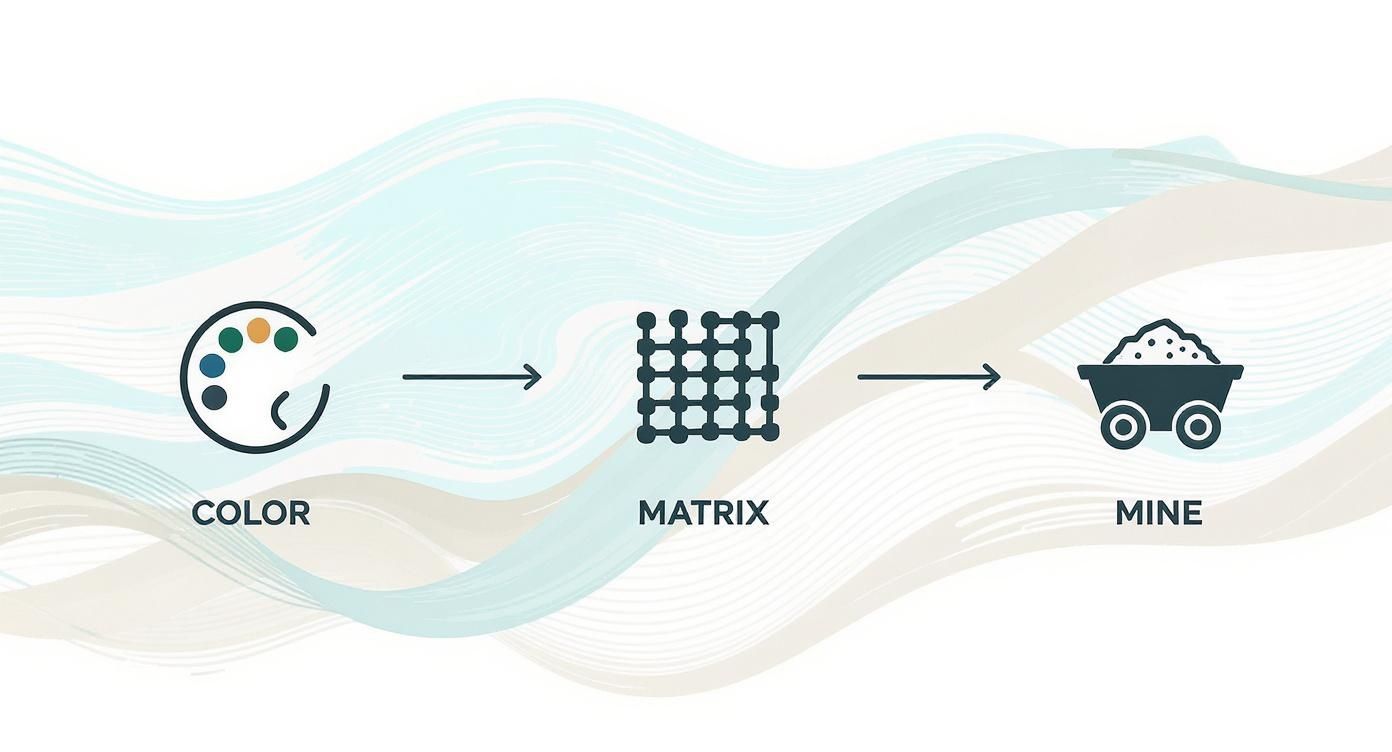
Getting familiar with these elements—the color, the matrix, and the mine it came from—is your first step to styling your collection like a pro, since they all shape the vibe of your jewelry.
Artfully Mixing Textures and Metals
The Southwestern cowgirl look is all about rich textures, and your jewelry should play right into that. Turquoise looks incredible next to all sorts of materials, creating a layered, lived-in style that's full of character. Don't ever be afraid to mix things up.
- Silver and Leather: This is the absolute classic Southwestern combo. The cool shine of sterling silver makes the vibrant blue of the turquoise pop, while the warm, earthy feel of a leather cord or cuff adds that perfect touch of rugged authenticity.
- Denim on Denim: Seriously, nothing makes turquoise stand out quite like putting it against denim. A turquoise necklace over a chambray shirt or a bold cuff pushed up the sleeve of a jean jacket is a timeless look that’s just effortlessly cool. For more ideas, check out our guide on cowgirl necklace styles that elevate denim.
- Stacking and Layering: To get that more personal, bohemian vibe, start experimenting with stacks. Mix delicate turquoise rings with plain silver bands, or layer a simple turquoise pendant with a few longer silver chains. The key here is to play with different lengths and textures to create a look that's interesting and uniquely you.
At the end of the day, styling turquoise is all about intuition. It's about feeling a connection to the stone and letting its story and beauty become a part of your own. Whether you go for one single, knockout piece or a whole curated collection of favorites, just wear it in a way that feels like you. Let your jewelry be more than just something you put on; let it be a reflection of your adventurous spirit.
Wearing Turquoise with Cultural Respect
When you own a piece of jewelry with such a deep and sacred history, you also carry a responsibility to honor where it came from. The profound meaning behind turquoise is rooted in Native American culture, and wearing these beautiful creations calls for a bit of mindfulness and a lot of respect. It’s about shifting your perspective from just admiring a style to genuinely appreciating the story, the artistry, and the spirit poured into each piece.
This shift starts when we understand the huge difference between cultural appropriation and cultural appreciation. Appropriation is when someone takes elements from a culture without permission or understanding, often just for profit, which strips away all the original meaning. Appreciation, on the other hand, is all about learning, respecting, and actively supporting the source culture.
When you wear turquoise, you have the chance to be an ally. By seeking out authentic, artisan-made jewelry, you're directly supporting Indigenous creators, their families, and the ongoing preservation of their heritage.
Moving from Appropriation to Appreciation
Making a conscious choice to honor the culture behind your jewelry is a powerful thing. It turns you from just another consumer into a thoughtful collector who truly values the hands-on craftsmanship and authenticity. The idea is to wear these pieces not as a costume, but as a sincere tribute to the artists and ancient traditions that brought them to life.
A great first step is to educate yourself about the symbols and designs you’re wearing. For example, an animal motif in Zuni jewelry isn't just a pretty shape; it holds specific spiritual weight. A bear represents courage and strength, while an eagle symbolizes a direct connection to the Creator. Knowing this adds a whole new layer of depth to your connection with your jewelry.
True appreciation means recognizing that Native American jewelry is not a trend. It is a living, breathing art form—a continuation of ancestral knowledge and a vital part of a resilient cultural identity.
Supporting Authentic Indigenous Artisans
The most direct way to wear turquoise respectfully is to make sure your money goes to the hands that actually made it. Unfortunately, the market is flooded with mass-produced fakes that mimic Native American styles but have none of the soul—or the quality—of the real thing.
Here are a few practical tips to help you become a more ethical buyer:
- Look for Hallmarks: Many Native American artists stamp their work with a unique hallmark—maybe an initial, a symbol, or a name that identifies them as the creator. While not every authentic piece has one (especially older items), it’s a strong sign you’re looking at the real deal.
- Ask Questions: Don't ever be shy about asking a seller about the artist. A reputable dealer will be proud to tell you about the artisan’s tribal affiliation and background.
- Buy from Reputable Sources: Purchase your jewelry from trusted galleries, directly from artists at markets, or from online stores that are transparent about their relationships with Indigenous creators. This is the best way to ensure artisans are paid fairly for their incredible skill.
By choosing authenticity, you’re doing so much more than just buying a beautiful accessory. You become a guardian of a cultural legacy, helping ensure that the sacred meaning of turquoise continues to be honored and that its traditions thrive for generations to come.
Got Questions About Turquoise Jewelry? We’ve Got Answers.
As you start your journey with turquoise, a few questions naturally pop up. Getting some straight answers helps you wear, collect, and care for your pieces with total confidence. Here are a few quick insights to round out your understanding of this incredible stone.
One of the first things people ask about is durability. Turquoise lands between a 5 and 6 on the Mohs hardness scale, which makes it softer than super-tough gems like diamonds or quartz. This just means it needs a little thoughtful care—it can get scratched by harder materials, so keep it away from harsh chemicals and rough surfaces.
Another common point of curiosity? What gives turquoise its incredible range of colors. Those famous vibrant blues come from the presence of copper in the stone. When you see those beautiful green and teal shades, that’s usually a hint of iron or zinc in the mix.
How Can You Tell if Turquoise Is Real?
Spotting authentic turquoise is a crucial skill for any collector, and while it takes a bit of practice, you don't have to be a gemologist. There are a few key signs that can help you tell a genuine stone from a common imitation like dyed howlite.
- Look for Natural Imperfections: Real turquoise is rarely, if ever, perfect. It almost always has unique variations in its color and a distinctive matrix—that beautiful web of host rock running through it.
- Check the Price Tag: Genuine, high-quality turquoise is a valuable gemstone. If you see a price that seems way too good to be true, it probably is.
- Feel its Texture: Authentic turquoise is a stone, so it should feel relatively dense and cool to the touch. Many plastic fakes will feel suspiciously light and warm up quickly in your hand.
Honestly, the surest way to guarantee you're getting the real deal is to buy from reputable sellers. Look for shops that work directly with Native American artisans and are totally transparent about where their pieces come from. This way, you support the creators and know you're investing in a true work of art.
Can Turquoise Change Color Over Time?
Yes, it absolutely can! This is actually one of its most unique and cherished characteristics. Turquoise is a porous stone, which means it can absorb things from its environment, like the natural oils from your skin or traces of lotions.
Over many years of being worn and loved, a piece of turquoise might slowly deepen in color, shifting from a bright, light blue to a richer, deeper green. Many people call this a "living stone" effect. For collectors, this natural patina is highly prized because it shows the stone has a history and has become a part of its wearer's story. With proper care, like avoiding chemicals, you can help manage this process and preserve its beauty for a lifetime.
At Silver Elegant, we celebrate the rich history and authentic beauty of Southwestern jewelry. Our curated collections feature stunning turquoise pieces designed to connect you to a legacy of artistry and spirit.