

So, you've found a piece of Southwestern or estuarian cowgirl jewelry that's calling your name. That stunning blue-green stone is captivating, but how can you be sure it's the real deal? The turquoise market is flooded with convincing fakes, and telling them apart is a skill every jewelry lover should have, especially when you're curating that perfect coastal cowgirl vibe.
Before you get into more detailed tests, a quick look and feel can tell you a whole lot.
Start With Your Senses: The Look and Feel Test
Genuine turquoise is a natural stone, and nature is rarely perfect. It’s the little imperfections that often signal authenticity. A stone that looks too uniform is usually the first red flag. You want to see natural variations, those subtle shifts in color that give each piece its own story, like a well-worn piece of sea glass or a river stone.
If you want to get a better sense of the incredible variety out there, you can explore the different meanings and shades of turquoise to see what authentic stones can look like.
When you have a piece in hand, here are the first things I always look for:
- Color That Breathes: Real turquoise almost never has a flat, solid color. Look closely for those subtle gradients and tonal shifts. A perfectly even, plastic-like blue is a major warning sign.
- A Matrix With Depth: The matrix—those web-like lines of host rock—should look like it's part of the stone, not painted on top. In genuine turquoise, these lines are often irregular and might even feel slightly recessed if you run a fingernail over them. Fakes tend to have a flat, surface-level pattern that lacks character.
- The Cool, Dense Feel: Pick it up. Real turquoise is a mineral and should feel cool and substantial, almost dense for its size. Plastic imitations are lightweight and often feel warm or at room temperature right away.
This infographic breaks down those three initial checks—Color, Matrix, and Touch—to help you remember what to watch for.

This simple, three-point check is your first line of defense, reinforcing that the key to spotting a fake is looking for the beautiful imperfections that are so hard to replicate.
Key Takeaway: Authentic turquoise tells a story through its flaws. A perfectly uniform color, a weightless feel, and flawless, flat matrix patterns are all signs that you might be looking at an imitation. Trust your gut—if something about a piece feels "off," it's worth a closer look.
Mastering this quick assessment will give you the confidence to evaluate Southwestern and estuarian cowgirl jewelry on the spot. It helps you filter out the obvious fakes before moving on to some of the more in-depth tests we'll cover next.
Real Turquoise vs Common Imitations At a Glance
To make it even clearer, I've put together a quick comparison table. When you're looking at a piece, think about where it falls on this chart. It's a handy cheat sheet for spotting the most common lookalikes.
| Characteristic | Real Turquoise | Dyed Howlite/Magnesite | Plastic/Resin |
|---|---|---|---|
| Color | Natural variations, subtle gradients. | Often too uniform or dye collects in cracks, creating a "spidery" look. | Flat, unnatural, and perfectly even color. |
| Matrix | Irregular, has depth, and is part of the stone. | Matrix pattern can look painted on or too perfect. | No natural matrix; any lines are surface-level and repetitive. |
| Feel/Weight | Cool to the touch, dense, and feels substantial. | Can feel dense but might have a slightly waxy or chalky texture. | Lightweight, warm to the touch, and feels like plastic. |
| Luster | Waxy to sub-vitreous (dull) luster. | Can be overly glossy from dye treatments. | Often has a shiny, artificial plastic sheen. |
This table isn't foolproof, as some fakes are getting incredibly sophisticated. However, it's an excellent starting point that covers 90% of the imitations you're likely to encounter in the wild. If a stone checks all the boxes for Howlite or Resin, you can probably save your money.
Reading the Visual Cues of a Genuine Stone
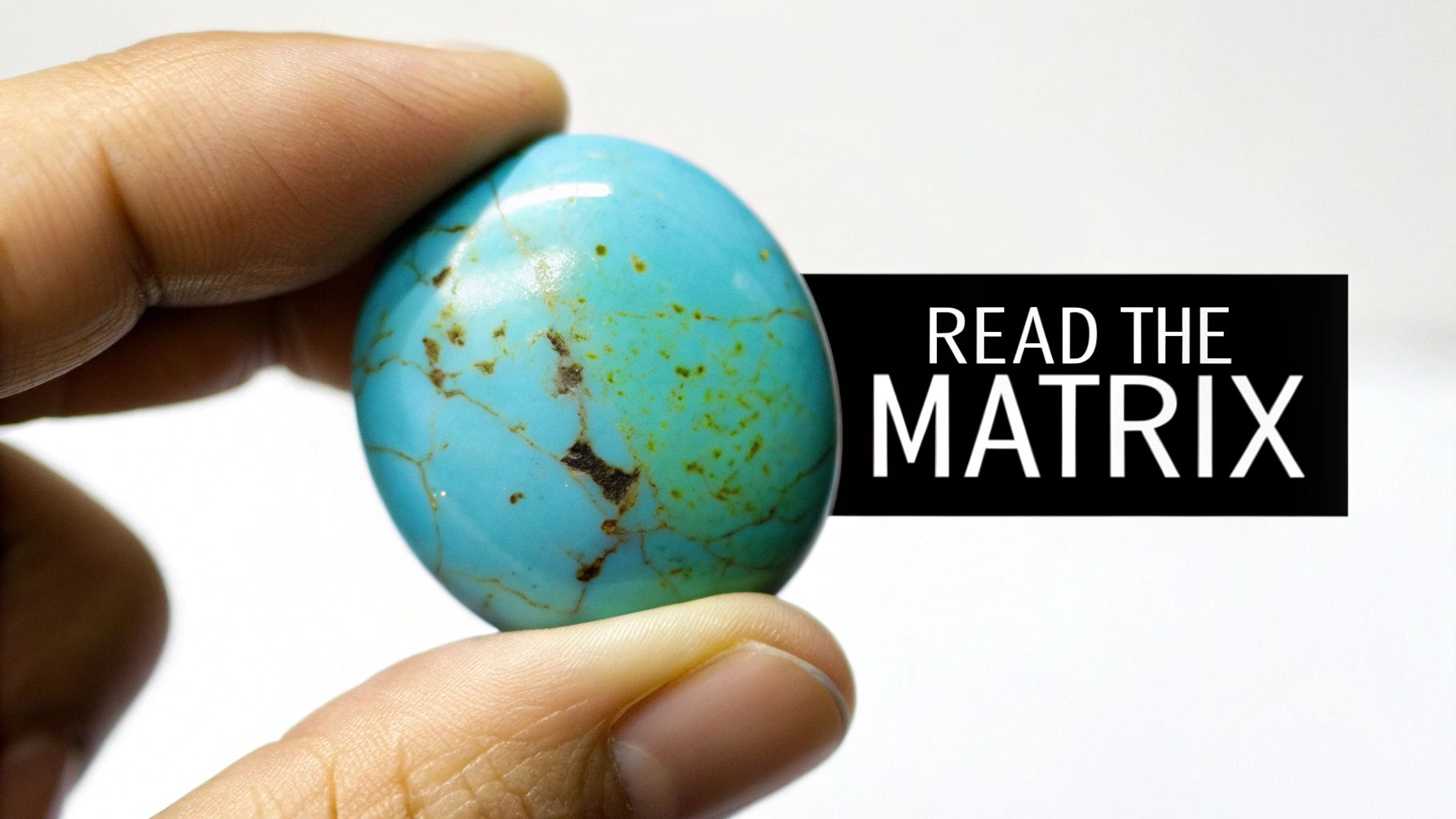
Every real turquoise stone tells a story, and the first chapter is written in its visual details. Before you even think about physical tests, just taking a good, hard look can reveal almost everything you need to know. Honing your eye for these subtleties is your best defense against fakes, especially when you’re browsing for Southwestern and estuarian cowgirl jewelry.
Forget about a perfectly uniform color. That’s one of the biggest red flags. Genuine turquoise almost never comes in one solid, flat shade. Instead, you should see gentle gradients and subtle shifts in its blues and greens, sometimes all within the same piece. A stone that looks as even as plastic probably is.
The Story in the Matrix
That web-like pattern running through the stone? That’s the matrix, and it’s one of the most telling features. It’s the remnant of the host rock where the turquoise formed, and it’s incredibly difficult to fake convincingly.
- Look for Irregularity: Nature isn't perfect, and neither is a real matrix. The lines should wander, change in thickness, and feel completely random.
- Check for Depth: Gently run a fingernail over the surface. Often, a real matrix is slightly recessed, creating a bit of texture. This happens because the host rock is sometimes softer than the turquoise itself.
- Beware of Painted Lines: Fakes, especially dyed howlite, often have a matrix that looks like it was drawn on with a marker. These lines will be perfectly flush with the surface and might have a suspiciously uniform, repeating pattern.
Getting a feel for an authentic matrix is a crucial part of learning how to identify real turquoise. That perfect, cookie-cutter "spiderweb" look is often a dead giveaway for an imitation.
Real turquoise has character flaws. It’s the subtle color variations and the imperfect, three-dimensional matrix that signal a stone pulled from the earth, not poured from a mold. A stone that looks too flawless is often just that.
Assessing Color and Luster
Now, let's talk about the stone’s color and the way it handles light. The spectrum of natural turquoise is huge, but imposters tend to miss the subtle qualities that give real stones their soul.
An intensely vibrant, uniform blue can sometimes be a warning. While some top-grade material like Sleeping Beauty turquoise is famous for its pure color, many fakes use dye to mimic this highly sought-after look. Scan for tiny spots where the dye might have pooled in cracks or areas where the color looks a bit too saturated.
The stone's luster, or its sheen, is another major clue. Real turquoise usually has a soft, waxy luster, not a glassy, high-gloss finish. Plastic and resin imitations just look too shiny and artificial. That slightly dull, waxy appearance is a signature trait that synthetics just can't get right.
To sharpen your eye even further, you can dive deeper into turquoise origin, quality markers, and care. Mastering these visual cues is the first step to confidently picking out authentic pieces for your estuarian cowgirl jewelry collection.
Practical At-Home Tests for Verifying Turquoise

Once you've trained your eye to spot the visual tells, you might be ready to get a little more hands-on. A few simple at-home tests can give you some pretty clear evidence about a stone's authenticity, helping you separate a genuine piece from a clever imitation.
The great thing is, these methods are low-risk and just require a few common household items. They’re perfect for that initial gut check.
The key is to always proceed with care, especially with finished jewelry. I always recommend testing a small, inconspicuous area, like the back of the stone or a spot tucked away near the bezel setting. This way, you can gather clues without accidentally altering the look of your piece.
The Acetone Test for Revealing Dyes
One of the most effective and straightforward checks is the acetone test. It's brilliant for spotting dyed howlite or magnesite. These porous white minerals are frequently colored to mimic turquoise, but the cheap dye they absorb is no match for a simple solvent.
To give it a try, just put a small amount of 100% acetone (your standard nail polish remover usually works) on a cotton swab. Then, gently rub it on a discreet part of the stone.
- What You're Looking For: If any blue or green color transfers onto that cotton swab, you've got your answer. The stone has been dyed, which means it’s not real turquoise.
- What It Means: Real, untreated turquoise will not react to acetone. Its gorgeous color is part of its mineral structure and won't just rub off.
A Word of Caution: While this test is perfectly safe for natural turquoise, it can potentially damage the finish on stabilized turquoise, which has been treated with resin. Always start on a tiny, hidden spot to minimize any risk to your jewelry.
The Fingernail Scratch Test
Here's another quick physical test that checks the stone's hardness. This one is particularly useful for telling real turquoise apart from its much softer impersonators. Turquoise has a Mohs hardness of around 5 to 6, which makes it relatively durable.
In contrast, fakes like howlite and magnesite are significantly softer, with a hardness of only about 3.5. It's a big enough difference that you can often feel it.
Gently but firmly, try to scratch the stone with your fingernail, preferably on the back or an edge. A fingernail has a hardness of about 2.5, so it shouldn't be able to leave a mark on real turquoise. If the stone feels chalky or scratches easily, that’s a major red flag.
The Hot Pin Test: A Last Resort
The hot pin test is definitely a more aggressive method, but it's the final word when it comes to identifying plastic or resin imitations. Just as the name implies, it involves touching a heated pin to the stone’s surface.
I have to stress this: use this test with extreme caution, as it will permanently damage the piece if it's fake.
Heat a pin or needle with a lighter for a few seconds and touch it to an out-of-the-way spot. If the stone is plastic, it will melt slightly and give off a distinct acrid, burnt-plastic smell. Real turquoise is a mineral—it won’t be affected by this brief, localized heat.
Because these tests can sometimes leave a little residue, knowing a bit about proper jewelry care is helpful. You can find some excellent tips in our guide on how to clean sterling silver jewelry at home, which offers safe practices for keeping your treasured pieces looking their best.
Understanding Turquoise Treatments and Lookalikes
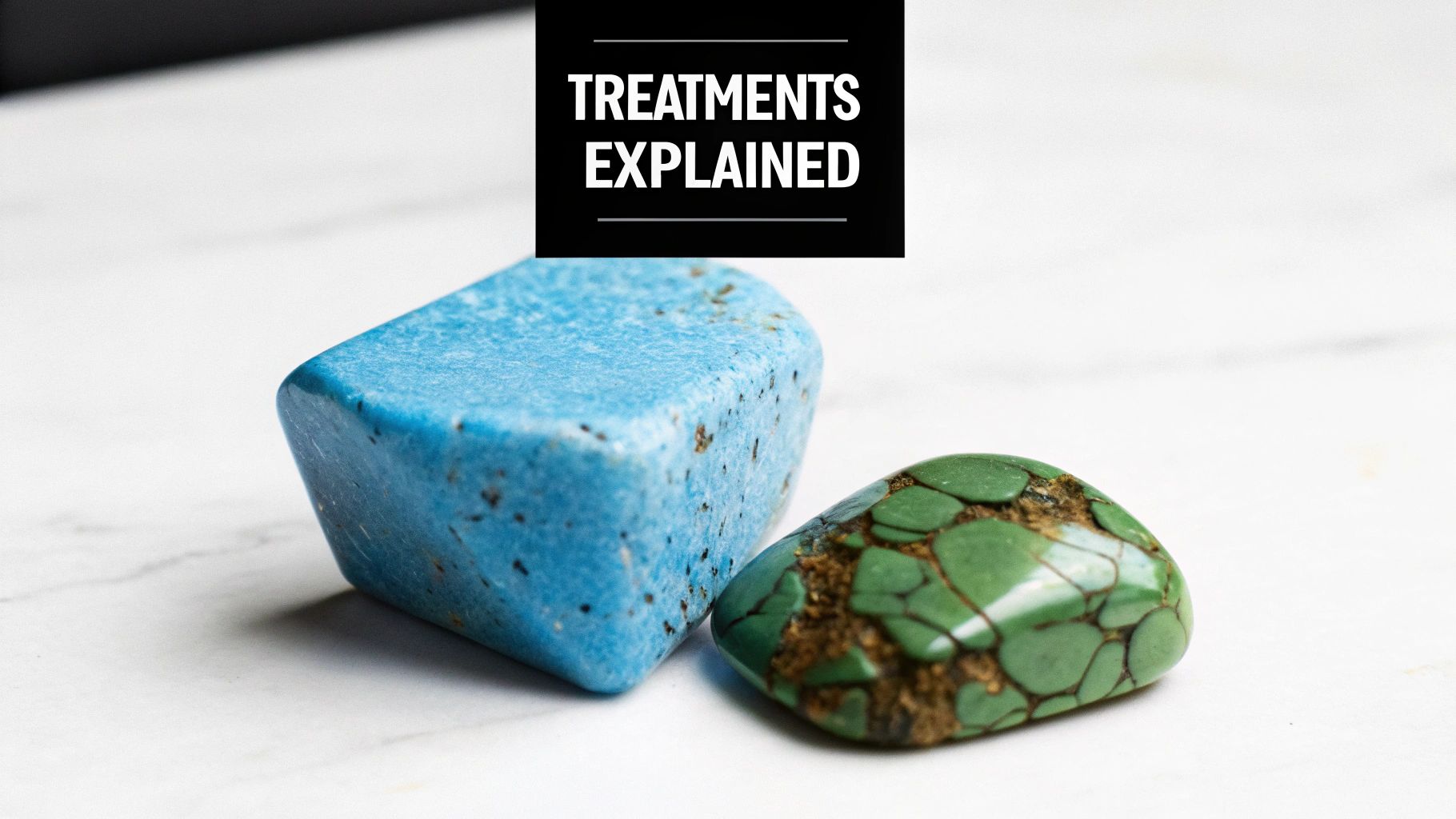
Diving into the turquoise market can feel a bit tricky, mostly because not every stone that's been altered is necessarily "fake." If you're building a collection of beautiful Southwestern or estuarian cowgirl jewelry, you need to know the difference between common treatments and outright imitations. This knowledge is your best defense and helps you appreciate what you're really buying.
You'll often come across stabilized turquoise. This is genuine, but naturally porous, turquoise that has been infused with a clear epoxy or resin. The treatment makes it harder, deepens its color, and ensures it's durable enough for jewelry. The truth is, only a tiny fraction of turquoise mined is hard enough to be used in its natural state, so stabilization is a widely accepted and necessary industry practice. It keeps fragile stones from crumbling.
Then there's reconstituted turquoise. This is a whole different ballgame. It’s made by mixing turquoise dust and small chips with resin and then pressing it all into a solid block. While it technically contains real turquoise, it's considered a much lower-grade product than even a stabilized stone.
Distinguishing Treatments from Fakes
Getting a handle on the difference between treated turquoise and complete fakes is the core of learning how to identify real turquoise. While stabilized and reconstituted stones have their place, especially in more affordable designs, some materials are just pure imitations.
- Dyed Howlite and Magnesite: These are the fakes you'll see most often. They are naturally white, porous minerals that soak up blue dye beautifully, making them a convincing substitute at first glance.
- Plastic and Resin (Block): This is entirely man-made material with zero actual turquoise. It's usually lightweight, the color is suspiciously uniform, and any "matrix" webbing often looks like it was painted on with a sharpie.
The distinction here is crucial. A reputable seller will be transparent about offering stabilized turquoise. But selling dyed howlite as genuine turquoise is a flat-out misrepresentation.
Even with fun, affordable costume pieces, like a stylish faux turquoise cross pendant necklace, honesty is what matters. It all comes down to knowing exactly what you’re paying for.
The Zachery Treatment: A Special Case
To make things even more interesting, there’s an advanced process called the Zachery treatment. This method enhances a stone's color and hardness without using any plastic or resin, which makes it nearly impossible to spot with the simple tests you can do at home. It essentially alters the stone's own chemistry to improve its stability and look.
Gemological labs have found that a huge portion of the turquoise on the market has been altered in some way. Some studies estimate that treatments like the Zachery method are used on 20-30% of turquoise in certain markets. This just goes to show why getting a professional opinion can be so important when you're investing in a high-value piece.
When to Call in a Professional Gemologist
While the at-home tests are fantastic for weeding out the most common fakes, they definitely have their limits. When you’re looking at a potentially high-value antique, a rare piece from a famed mine, or a treasured family heirloom, the stakes are just so much higher.
This is where you need to bring in the big guns: a professional gemologist.
Some of the more sophisticated fakes and advanced treatments on the market today can easily fool an untrained eye. A simple visual check just isn't going to cut it when you're up against subtle enhancements or synthetics that were crafted with expertise. For your most prized Southwestern and estuarian cowgirl jewelry, investing in a professional appraisal is all about peace of mind.
Knowing the Limits of At-Home Tests
Simple checks like the acetone or scratch test work wonders against low-quality imitations—think dyed howlite or basic plastic. But they fall short when you're dealing with more advanced materials or treatments that don't rely on simple dyes or soft plastics.
You absolutely need an expert in these situations:
- High-Value Pieces: If a seller claims a stone is rare turquoise, like Lander Blue or Bisbee, professional verification isn't just a good idea—it's non-negotiable. This confirms its provenance and protects you from a costly mistake.
- Antique Jewelry: Authenticating the turquoise in vintage Southwestern jewelry is a specialized skill. An expert understands the historical materials, lapidary styles, and craftsmanship of different eras.
- Unknown Origins: If you've inherited or found a piece with no backstory, a gemologist can help identify not just the stone but potentially its origin. This is a crucial step when you're learning how to identify real turquoise.
The Advanced Tools a Pro Uses
A certified gemologist has access to equipment that goes way beyond a simple magnifying glass. These tools can analyze a stone's core properties without causing a single scratch, offering definitive proof of what it is.
One of the most trusted methods is Raman spectroscopy. This tech shines a laser on the stone and reads the molecular vibrations back, creating a unique "fingerprint." It can instantly tell real turquoise apart from a simulant like microcline, which has totally different spectral bands. This kind of powerful analysis is a cornerstone of gem authentication in major markets.
Key Takeaway: For any piece where authenticity dramatically impacts its value—like an antique Zuni needlepoint necklace or a high-grade Navajo cuff—a gemological report is your best insurance policy. It's unbiased, scientific proof of what you really have.
These advanced methods can even pinpoint a turquoise stone's mine of origin by analyzing its trace elements. This creates a "chemical fingerprint" that links the stone back to a specific location, adding incredible history and value to your piece.
If you're looking to buy something with a specific mine origin, a great first step is to explore some of the best places to buy turquoise jewelry from dealers who value transparency. Ultimately, when the story and value of your jewelry hang in the balance, a professional opinion is always a wise investment.
Got More Questions? Let's Clear Things Up.
Even after you've learned the visual tells and quick at-home tests, a few questions always seem to pop up. That's completely normal. The world of turquoise is wonderfully complex, and getting a feel for the real thing is a skill you build over time.
Here are answers to some of the most common questions I hear when people are just starting out. Getting these down will help you make much smarter choices for your Southwestern jewelry collection and protect your investment.
Does Real Turquoise Always Have a Matrix?
This is a fantastic question, and the answer is no. In fact, some of the most coveted and valuable turquoise on the market, like the famous Sleeping Beauty from Arizona, is prized for its pure, robin's egg blue color with absolutely no matrix at all. It's a clean, classic look you'll often see in high-end estuarian cowgirl jewelry.
That said, for most turquoise you'll encounter, the matrix is one of your best friends for spotting authenticity. A natural, irregular web of host rock that feels slightly recessed to the touch is a very strong sign you’re looking at genuine stone. The trick isn't just seeing a matrix, but learning to recognize a natural one.
Can the Price Tell Me If It's Real?
Price is a massive clue. If you stumble upon a large, vibrant turquoise necklace with a price tag that seems too good to be true, it almost certainly is. Real, high-quality turquoise is a rare and precious gem, and its cost reflects that scarcity, the mine it came from, and the artisan's skill.
My Two Cents: While you can find great deals on smaller, authentic turquoise pieces, a ridiculously low price on a substantial piece is a huge red flag. Always use price as your first reality check, especially when you're shopping online.
This doesn't mean every affordable piece is fake, but you have to be skeptical of those "steal of a lifetime" bargains. More often than not, they point straight to dyed howlite, magnesite, or just plain plastic.
What's Stabilized Turquoise? Should I Avoid It?
You shouldn't necessarily avoid it, and it's important to know what it is. Stabilized turquoise is real turquoise that was too porous or soft to be used in jewelry in its natural state. It's been infused with a clear resin to make it harder, more durable, and to deepen its color.
This is an accepted and extremely common industry practice. A huge percentage of the turquoise mined today requires stabilization to become usable.
The key is transparency. Stabilization makes a genuine stone durable enough for jewelry. What you do want to avoid is "reconstituted" turquoise, which is basically turquoise dust and fragments mixed with resin and dye. A reputable seller will always be upfront about whether a stone is natural, stabilized, or treated in any other way. Knowing exactly what you're buying is what matters.
At Silver Elegant, we believe in the beauty of authentic design and transparent quality, bringing you stunning Southwestern and estuarian cowgirl jewelry you can trust. Explore our curated collections and find your perfect piece today.